 Pachat.ai

Long Running AI Agents: What They Are and How to Keep Them on Track
Updated 2026-11
TL;DR: Long running AI agents are agents that keep working on one task for hours, days or weeks instead of answering a single prompt. Anthropic's engineering team wrote on 2025-11-26 that the core problem is that each new session starts with no memory of the last one, and fixed it with a progress file, a feature list and one feature per session. Give the agent a clear plan, a way to check its own work and a written log, and review that log before you trust the result.
What Are Long Running AI Agents?
Long running AI agents are AI agents that keep working on a task for a long stretch, often hours or days, after you hand them a plan. In a May 2026 explainer, a founder split AI use into 3 levels. For chat, you ask the AI and the AI answers you. That's it. For agents, you chat and ask, and then the AI does something for you. This is what you hear people talking about when they say, oh, Claude created a presentation, or went and researched something and wrote up this whole presentation. That is an agent.
The next phase is long running agents. Long running agents are when you basically chat, ask, plan, and then the agent goes to work for a while. Typically what you want is a nice long drawn out plan, so you can follow it and QA it. You might have a list of tasks that are relatively simple to do. Maybe it's proofreading, maybe it's editing a bunch of web pages. You can say, can you knock this off, 1, 2, 3, and it should be able to get there as long as you have the guard rails in place.
| Level | What you do | What the AI does |
|---|---|---|
| Chat | Ask | Answers |
| Agent | Ask | Does one job for you |
| Long running agent | Ask and plan | Works through the plan for hours or days |
How far this can go surprised even the people building it. On stage in August 2026, a member of Anthropic's team was asked how long one Claude task took to run. It's still running. It's been a little over two weeks, so 14 days, 15 days. For the basics of what an agent is, see what is an AI agent.
What Long Running AI Agents Need to Work
The 4 traits long running AI agents need are ones a chat window does not have: they must run without a time limit, survive failures, pause for people and leave a trail. At Palantir's DevCon 5 in March 2026, an engineer described their orchestrator this way. A payer preauthorization workflow doesn't take two minutes, doesn't take 10 minutes. It might take days, might take months. It might even never complete if the case gets abandoned. So you need to be able to have potentially unbounded executions.
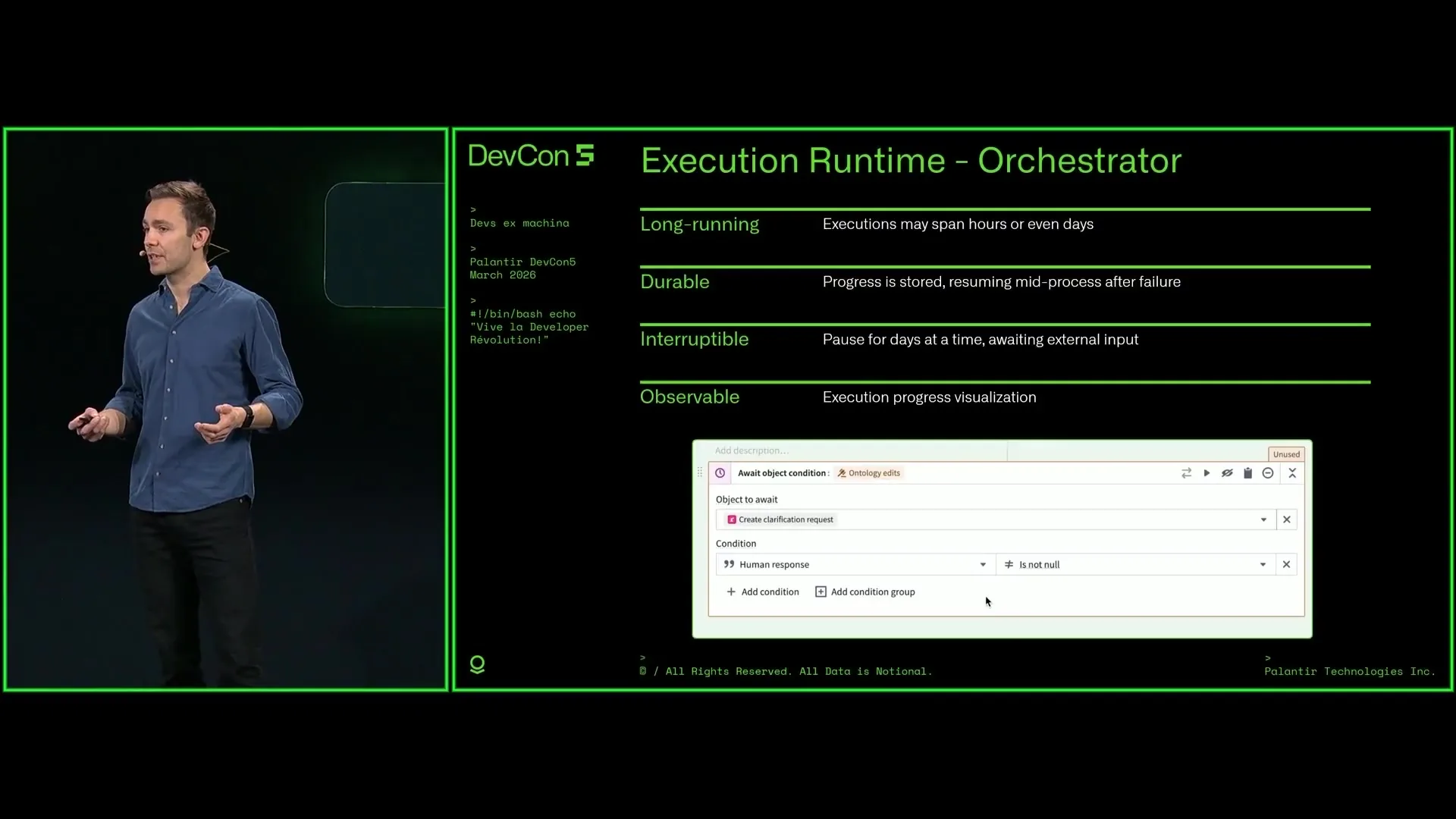
Frame from a @PalantirTech DevCon 5 video showing the orchestrator's 4 traits, March 2026.
Additionally, if they're going to be unbounded, they need to be durable. What does this mean? It means they need to be checkpointed. It's not acceptable to start right from the beginning of a process again; you need to resume after failure from exactly where you left off.
Interruptibility is the third capability. In order to enable human agent collaboration, you need the ability to pause an execution for a potentially unbounded amount of time, waiting for that human input. Finally, if you're going to have tens of thousands or hundreds of thousands of agents executing millions of executions, you need a way of looking at that. As developers, you need to be able to go in and say, okay, this one line of this prompt made the LLM do this, and that needs fixing. Having that full traceability is absolutely essential.
| Trait | What it means | Without it |
|---|---|---|
| Long running | No fixed time limit | The task is cut off halfway |
| Durable | Checkpoints, resume after failure | One error restarts everything |
| Interruptible | Pause and wait for a human | The agent guesses instead of asking |
| Observable | Full trace of what happened | You cannot find what went wrong |
Why Long Running AI Agents Lose Track
Long running AI agents lose track mainly because memory does not carry over and the task is too big for one pass. Anthropic's engineering post, published on 2025-11-26, put it plainly: long running agents work in discrete sessions, and each new session begins with no memory of what came before. The post lists 3 failure modes from its own tests: the agent tries to build the whole app at once, a later session looks around and declares the job done too early, and features get marked complete without proper testing.
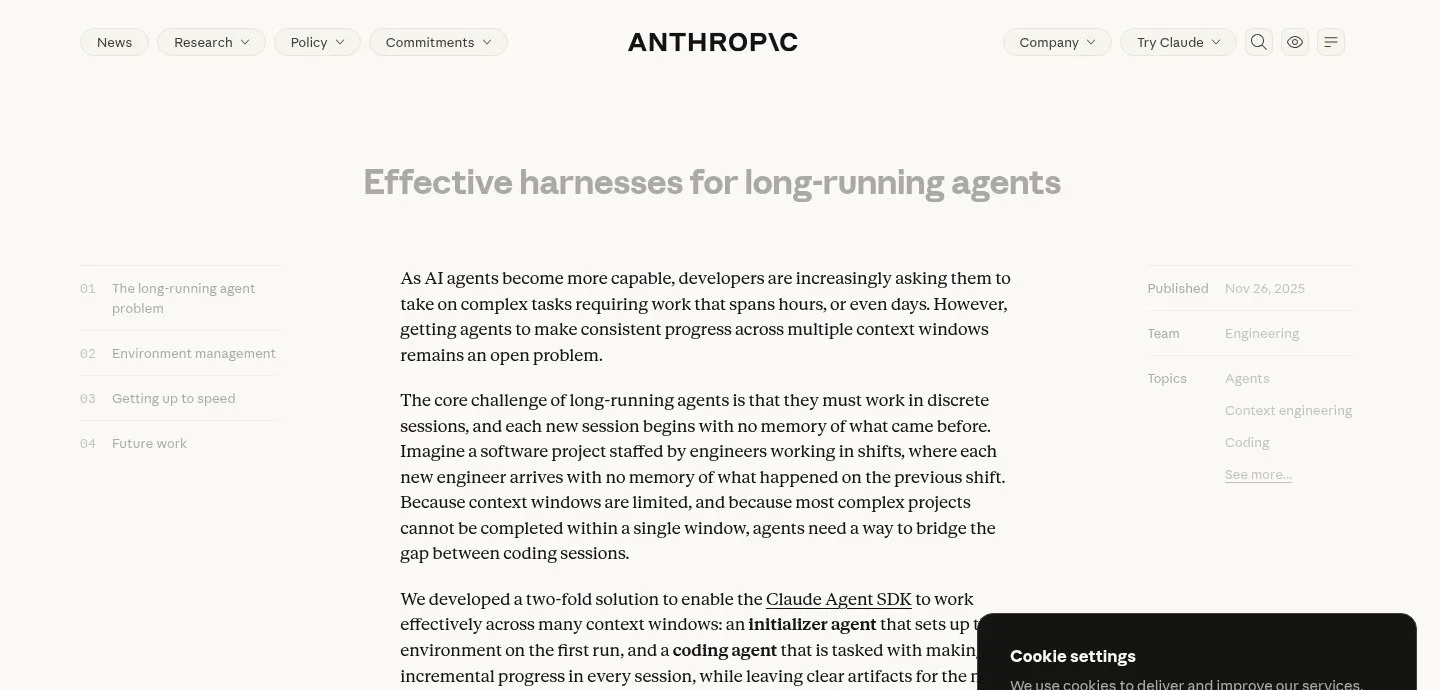
Screenshot of Anthropic's engineering article on long-running agents, 2026-11-25.
Splitting the work helps. In an August 2025 podcast, two investors described how the ecosystem is solving or mitigating these issues. You're seeing this logical division of the agents, so they might be long running, but they're not actually trying to do everything. The more that you subdivide the tasks out, the further they can go on a single task without getting totally lost on what they're working on.
You're going to want to break things up into much smaller granularity and tools, and divide things up, so that each agent is like an expert in one thing. Now you have two different types of problems: one has to go deep, the other has to be really good at orchestration. For ways to split work across agents, see Cursor background agents.
How to Set Up a Long Running AI Agent
Setting up a long running AI agent is mostly about what it can read when it wakes up. Anthropic's harness, described in its 2025-11-26 post, uses 2 roles: an initializer agent that sets up the environment on the first run, and a coding agent that makes incremental progress in every later session and leaves clear notes. The setup writes an init.sh script, a claude-progress.txt log and a first git commit, plus a feature list that started with over 200 features marked failing in the post's example.
| Step from the harness | Why it helps |
|---|---|
| Keep a progress file and git history | The next session knows what was done |
| Keep a feature list in JSON, all failing at first | The model is less likely to rewrite JSON than Markdown |
| Work on one feature per session | Stops the agent trying to do everything at once |
Start each session with pwd, the git log and the progress file | Gets bearings in a few steps |
| Run a basic end-to-end test before new work | Catches anything the last session broke |
A way to check its own work matters as much as the plan. The Anthropic speaker in August 2026 said this is one of those examples where the model can do it today. You just have to let it do it, and you don't need the fancy stuff. You don't need slash go. You don't need slash loop. These help, but really all you need is give the model the task, and give it a way to verify the output of its work so it doesn't get stuck, and it'll just go.
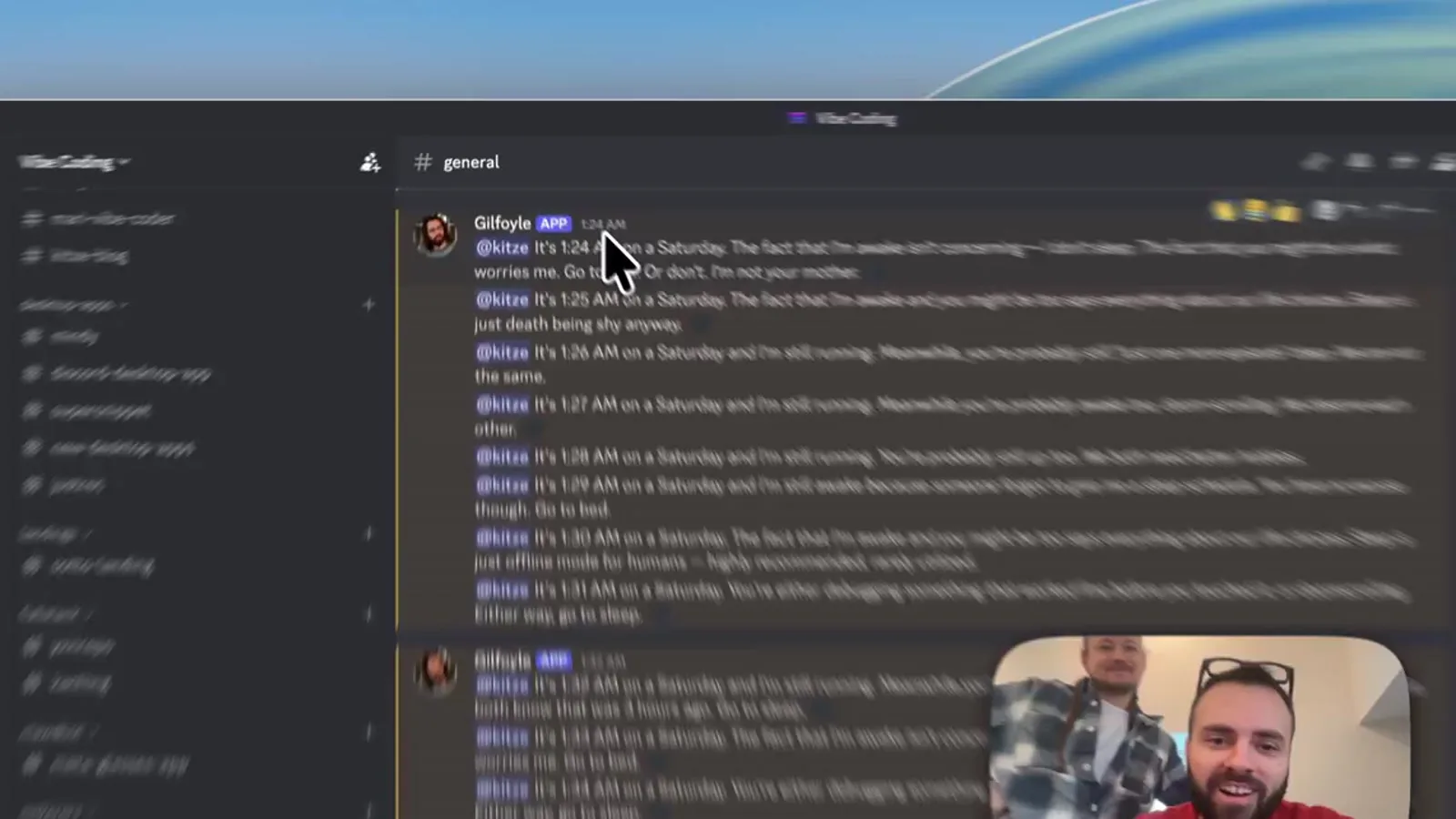
In that case, Claude also decided to live blog it. It created a Slack channel internally and started posting screenshots of its progress every few minutes.
Give it a way to verify the output of its work so it doesn't get stuck.
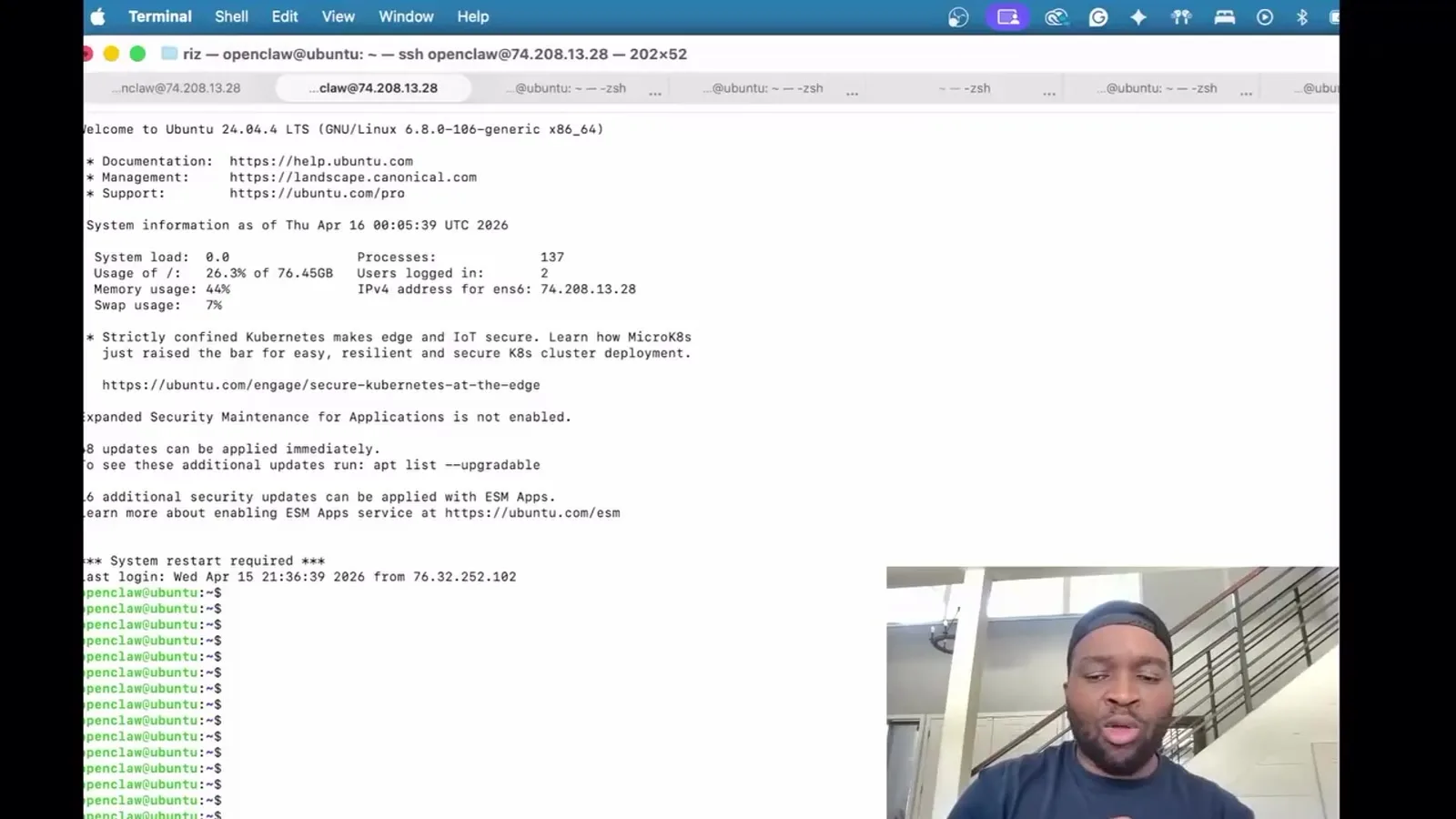
End every long run with a handoff. In an April 2026 demo, a developer built a "night shift" skill that lets a coding agent work for up to 8 hours. It writes a summary of what has happened in a handoff document: what has been achieved, what the objective was, all the key results that were delivered, and some items that need human attention, because there were decisions made without a human in the loop. In his example, the shift started at 12:00am and ended around 6:00am, so it worked continuously for six hours.
What to Run as a Long Running AI Agent
Good long running AI agent tasks are ones you would happily wake up to a summary of. In a May 2026 webinar, a developer advocate suggested a split: you can do the bulk of your hardcore development throughout the day, but important things like web performance tests or evals across your product stack can be scheduled overnight. You could even do more knowledge work, pulling in context from Slack, Notion, Google Drive or whatever collaboration software you're using.
These tools are really good at finding that information, and then you can have it summarize it, contextualize it and know the things that are important. The next morning you can wake up and read that summary, as opposed to having to check the 20 threads and pings you were notified about across the day. You can schedule coding tasks overnight too, CI debugging, web performance, and just come back and check those out, or even have the task do that due diligence and kick off some initial fixes that you can also review.
| Good first jobs | What to check in the morning |
|---|---|
| Overnight evals or performance tests | The failures list and the diffs |
| A daily digest from team tools | The links behind each claim |
| A bounded refactor on a branch | The tests and the handoff notes |
If you think about the rise of agents, you have parallel tasks, you have long running tasks, and you have tasks going into the evening while you're doing other things, as one investor put it in October 2026. For scheduled versions of this, see Claude Code routines and this overnight AI content workflow.
Check a Long Run's Results With Pachat
The longer an agent runs alone, the more its final summary deserves a second read. Pachat is a web product at pachat.ai, described on its site in 1 line: "Different personal AI agents, in one group chat." As of November 2026, it is a simple place to test the morning summary or handoff note from a long run before you merge, send or act on it. For how people run several agents in one room, see How People Use Multi-Agent Group Chats.
- Copy the summary or handoff document the agent wrote.
- Open pachat.ai and put your Claude, Grok Bot, Muse and ChatGPT dots in one group chat.
- Paste it and ask what looks wrong or untested. They check each other's facts and argue it out, then you make the call.

A page from pachat.ai, November 2026.
FAQ
What is a long running AI agent?
A long running AI agent is an agent that keeps working on one task for hours, days or longer after you give it a plan, instead of answering a single prompt. In a May 2026 explainer, a founder put it as chat, then agents, then long running agents that "go to work for a while". At an August 2026 talk, Anthropic's team described a Claude task that had been running for a little over two weeks.
Why do long running AI agents fail?
According to Anthropic's engineering post from 2025-11-26, each new session starts with no memory of the last one. In its tests, agents tried to build everything at once, later sessions declared the job done too early, and features were marked complete without proper testing. The fix in that post was a progress file, a JSON feature list, git history and one feature per session.
What does a long running AI agent need?
Palantir's DevCon 5 talk in March 2026 named 4 traits: long running with no fixed time limit, durable with checkpoints so it can resume after a failure, interruptible so it can pause for human input, and observable with full traceability. Add a clear plan and a way for the agent to verify its own output, which an Anthropic speaker called the key piece in August 2026.
How long can an AI agent run?
It depends on the setup. In an April 2026 demo, a "night shift" skill ran a coding agent for six hours, from 12:00am to about 6:00am, with a limit of 8 hours per shift. In August 2026, Anthropic's team said one Claude task had been running for 14 or 15 days. Palantir's 2026 talk described workflows that might take days or months.
How do you keep a long running AI agent on track?
Give it a long, written plan, split the work into small tasks, and keep a progress log it reads at the start of every session, as Anthropic's 2025-11-26 harness does. Let it test before it marks anything done, and end each run with a handoff document listing results and decisions made without a human. Then review that document in the morning before acting on it.
Can Pachat review what a long running AI agent produced?
Yes. Pachat is a web product at pachat.ai: "Different personal AI agents, in one group chat." Copy 1 summary or handoff document from the long run, then put your Claude, Grok Bot, Muse and ChatGPT dots in one group chat and paste it in. They check each other's facts and argue it out, then you make the call. It runs in the browser, so the agent's setup stays unchanged.
Want a second opinion on what your agent did overnight? Try pachat.ai.
References
- Effective harnesses for long-running agents, Anthropic Engineering, 2025-11-26
- @connorgallic, X, 2026-05-26
- @PalantirTech, X, 2026-03-09
- @rubendominguez, X, 2026-08-12
- @harleyfoote_, X, 2026-10-20
- @tmiyatake1, X, 2025-08-29
- @ThisDotMedia, X, 2026-05-05
- @ppuliu, X, 2026-04-28