 Pachat.ai
DeepSeek vs Claude for Coding Agents in 2026
Updated 2026-11
TL;DR: DeepSeek vs Claude is less about which brain is smarter and more about how you want your agent to run. In 2026 tests, DeepSeek Harness finished faster and stays open and swappable, while Claude Code produced the more polished result and keeps you inside Anthropic's system. Many builders now use both, with one model checking the other.
If you use the same AI model through two different doors, do you really get the same thing? That question sits under almost every DeepSeek vs Claude debate this year. The short answer: the door, the harness and the prompt change the result as much as the model does.
DeepSeek vs Claude: model, harness and agent
DeepSeek vs Claude is a comparison of two AI families: DeepSeek's models (V4 from April 24, 2026, V4.1-Flash from September 10, 2026) with the open-source DeepSeek Harness, and Anthropic's Claude models with Claude Code. An AI model like DeepSeek or Claude is the brain. It thinks, but on its own, it just sits there and answers questions. An agent is what gives that brain hands. It lets the model open files, run commands, search the web and actually do the work instead of just talking about it. The thing that connects the brain to the hands is called a harness.
Hold on to that word. It matters more than you'd think.
A language model on its own just generates text. It doesn't open a file. It doesn't run a task. The harness is the layer that wraps the model and turns it into a working agent, one that can read files, run commands and carry out multi step work. Claude Code does the same thing for Claude. If the idea of an agent is still new, start with what an AI agent is.
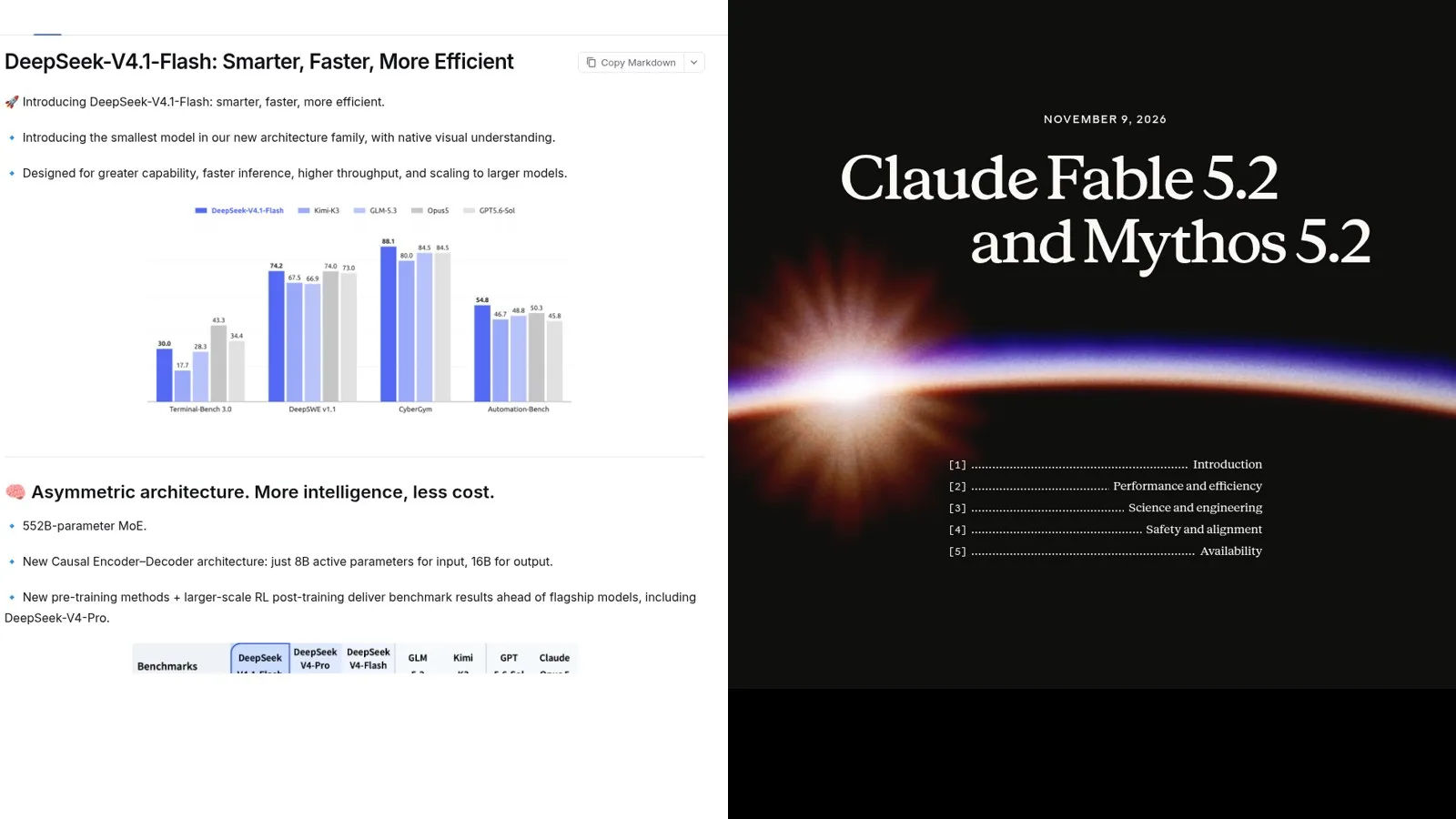
On the Claude side, Anthropic announced Claude Fable 5.2 and Mythos 5.2 on November 9, 2026, and it recommends starting with Claude Opus 5.5 as the daily driver. On the DeepSeek side, V4.1-Flash is the smallest model in its new architecture family, with native visual understanding.
Claude Code vs DeepSeek Harness: one bundle or everything a plugin
The biggest structural difference is that Claude Code bundles one vendor's model with a purpose built harness, while DeepSeek Harness unbundles them. DeepSeek made its harness repo public on August 13, 2026, under the MIT license, as a developer preview. The big idea behind DeepSeek Harness is that everything is a plugin. The model, the tools, the memory, the agent loop, all of it is swappable. The harness is a standalone product and the model is a plugin you can swap out. That's a genuinely different way of building this stuff.
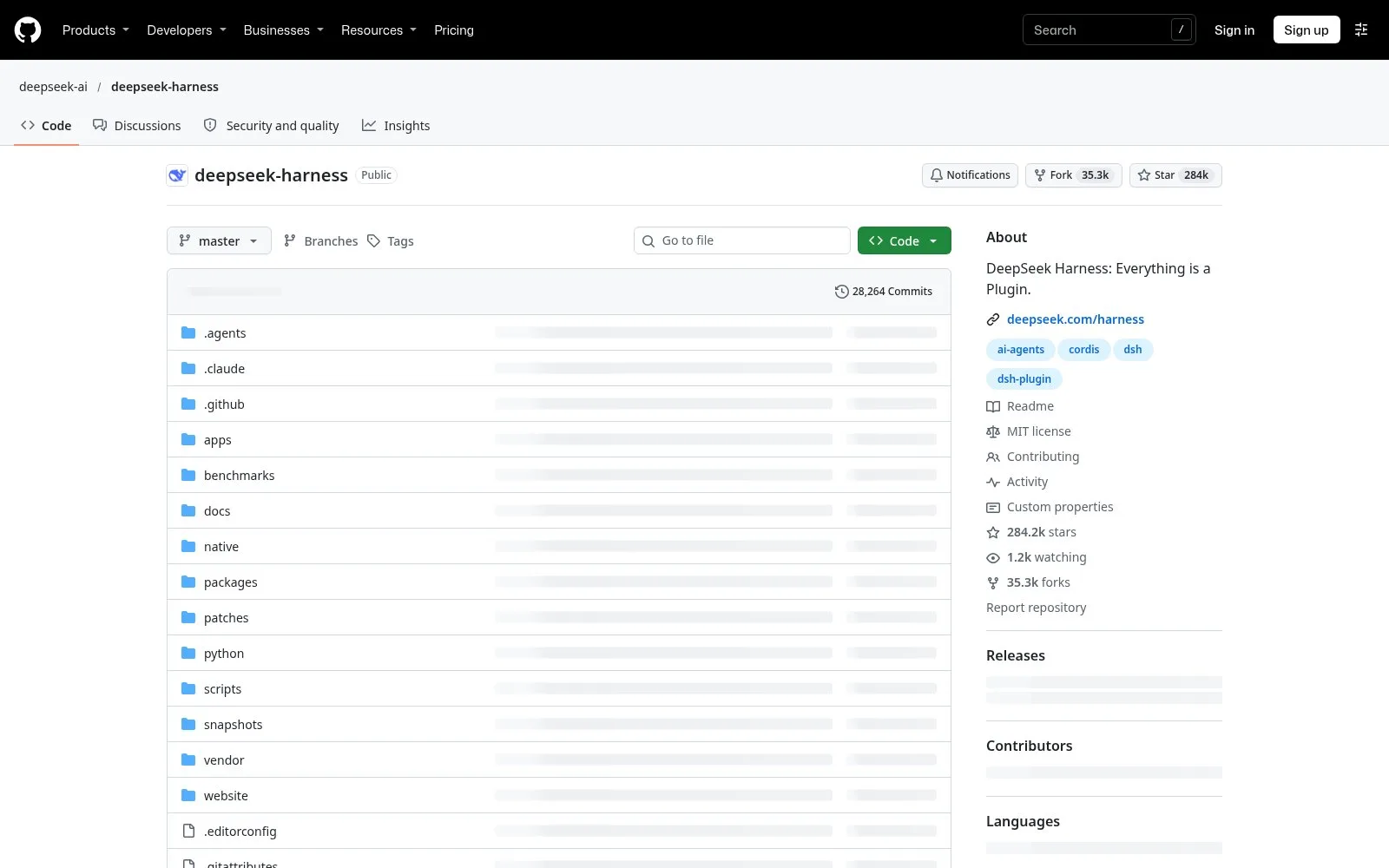
Screenshot: the deepseek-ai/deepseek-harness repository on GitHub, November 2026.
In practice, DeepSeek Harness is an open source harness that turns a chat model into an agent. It reads and edits your files, runs commands, makes a plan, hands work off to helpers. Every single part of the agent is a swappable block. You can pull one piece out, drop a new one in, and the whole thing keeps running. You don't have to touch the core code at all. You just change the setup.
It also has different modes for different jobs:
- a standard mode with the full toolkit;
- a code mode where the model writes little programs to run a bunch of steps at once;
- a minimal mode that strips everything down to just a couple of tools, which is great for testing;
- a creator mode where you build your own custom version of the agent.
Every single run is traceable. It records everything the model saw and did in one clean log. So if something goes wrong, you can rewind, look back and see exactly what happened.
Claude Code is incredible for autonomous coding, but Claude Code locks you into Anthropic's closed system, while DeepSeek Harness gives you complete open source control over your models, file tools, and execution loops. Anthropic, OpenAI, Kimi, GLM or your company's own gateway, they all plug in. So while everyone else waits for their AI app to add a feature, you just add it yourself.
Your AI agent just became something you build, not something you rent.
One catch: it's a developer preview. It runs real commands on your machine. So keep backups and use a container. It's early, it's moving fast and things will change and sometimes break as they improve it.
DeepSeek vs Claude on the same build: speed vs polish
Speed versus quality is the honest comparison right now. In one side-by-side test from August 2026, the exact same prompt went into both tools: build a 3D animated website and add a working Tetris game, one prompt, no extra context. DeepSeek Harness finished in 11 minutes. Claude Code was still going 30 minutes later. The DeepSeek output had functional animated icons floating around and Tetris working, but it felt cartoony and didn't quite match a professional site.
The Claude version was way more polished. The animations followed the mouse. It picked up on context given to it before. The game looks smoother. It felt more professional. But it took nearly three times as long to get there.
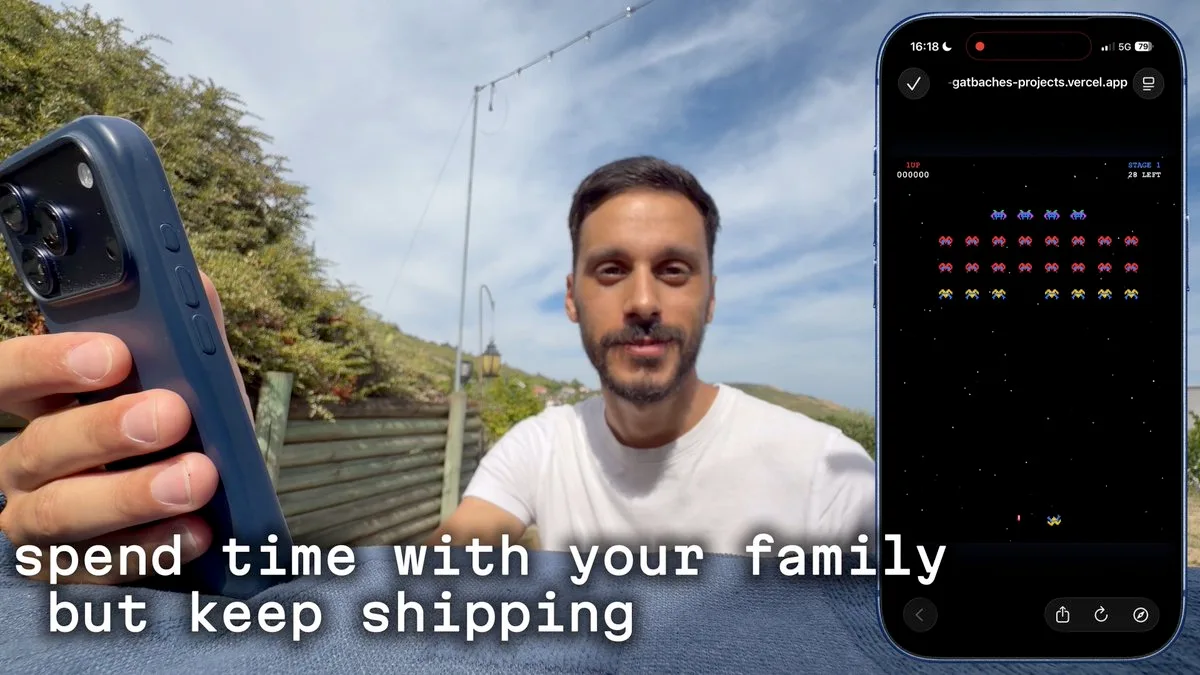
A second test, from October 2026, kept the model fixed and changed only the door: DeepSeek V4.1 Flash through its official API and through a second route. It wasn't just questions. It was a real coding agent that runs commands, edits files, lints its code and drives a browser to check its own work, with eight jobs: two 3D games and two websites, each from one line of prompt, and again from a full design brief.
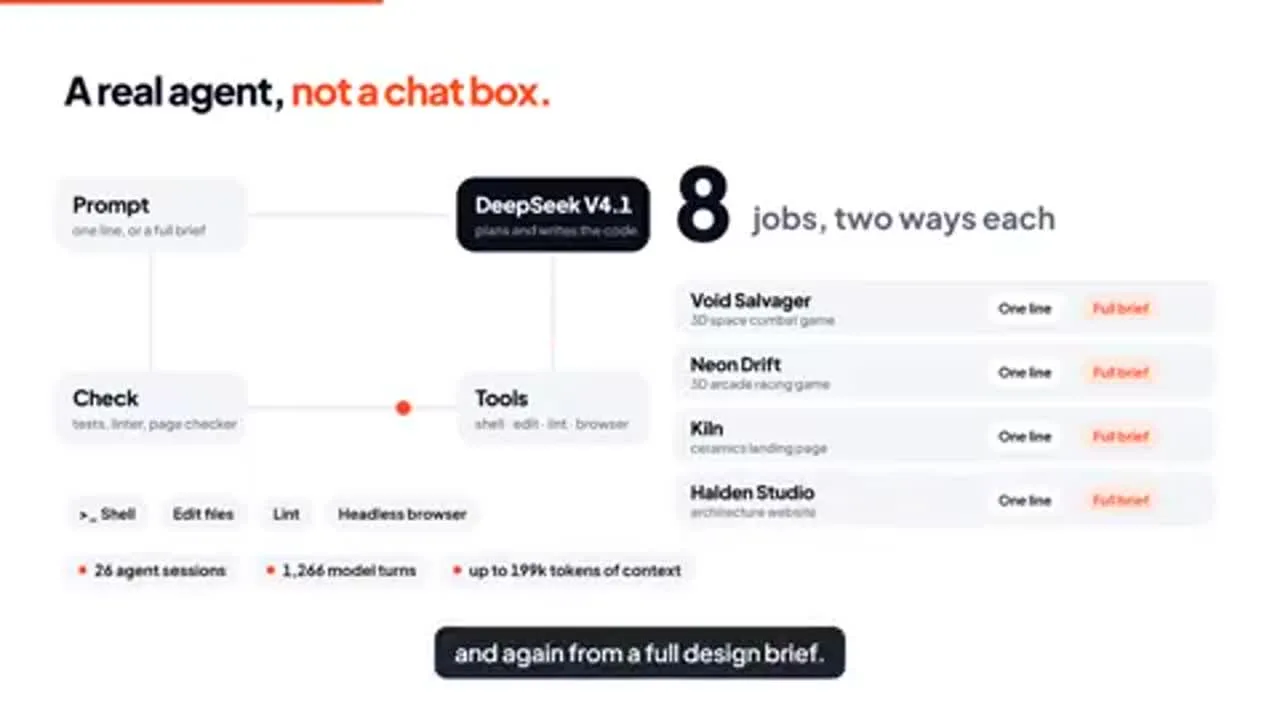
Frame from an X video by @UddipanBarman that ran DeepSeek V4.1 inside a real coding agent, October 2026.
First lesson, the prompt matters more than the door.
One line gets you the template: gradients, rounded cards, shadows on everything. A real brief gets you a real website. Both doors built playable 3D games, a space combat game with a radar and hundreds of asteroids, at 97 percent of the checks on both. Where they really differ is in how they run: the official API starts answering three times faster, 1.3 seconds to the first token against four.
So what should you do? The model's the same, so the quality is a tie. Put your effort into the brief. And whichever door you pick, let your agent check its own work.
Running DeepSeek locally: the open-model angle
Running DeepSeek locally means downloading an open DeepSeek model and chatting with it on your own computer, so the model runs inside your computer instead of a vendor's cloud. A tutorial from April 2026 shows the steps with Ollama. Ollama is a platform that simplifies running this type of large language models locally inside a computer. You head over to ollama.com, select DeepSeek R1, and pick a size such as 1.5 billion or 32 billion parameters, keeping in mind the size of these parameters according to your system's power.
Then you open your terminal and paste the command. This means that you will be able to run DeepSeek R1 locally inside your computer. You can chat and ask any question as you normally do inside ChatGPT. As it is a reasoning model, it will take time to think.
Inside a workflow tool, instead of the OpenAI chat model, you select the Ollama chat model, then the model you just downloaded. Now you can normally chat with your AI agent the same way.
DeepSeek vs Claude: which one to pick
Picking between DeepSeek and Claude is mostly a choice of working style, not a single winner, and the 2026 tests above point the same way. It's speed versus quality, open versus bundled, and how much you want to tinker with the setup. Claude Code bundles one vendor's model with a purpose built harness; DeepSeek Harness unbundles them. The table below uses facts from DeepSeek's and Anthropic's own pages as of November 2026, plus the 2 same-build tests above.
| DeepSeek | Claude | |
|---|---|---|
| Latest model news | V4.1-Flash, released September 10, 2026 | Fable 5.2 and Mythos 5.2, announced November 9, 2026 |
| Agent harness | DeepSeek Harness (open source, MIT, developer preview) | Claude Code |
| Swap the model | Yes, the model is a plugin | One vendor's model |
| Same-build test (August 2026) | Faster, more cartoony | Slower, more polished |
| Run on your own computer | Open models via tools like Ollama | Not stated |
Screenshot: claude.com homepage, November 2026.
Pick DeepSeek when you want speed, an open and modular harness, or a model on your own machine. Pick Claude when polish matters and you want a mature, purpose built agent. For more options on the Claude side, see these Claude Code alternatives and this guide on how to use Claude Code.
You also don't have to choose one or the other. DeepSeek Harness actually mounts Claude Code and Codex as sub agent providers. You can use DeepSeek Harness as the outer shell and have Claude Code running jobs inside it. You can even use it as an orchestrator and delegate different tasks to different models.
How to compare DeepSeek and Claude in Pachat
Pachat is "Different personal AI agents, in one group chat." Instead of switching tabs, you can chat with several AIs at once:
- Go to pachat.ai and sign in.
- Put your Claude, Grok Bot, Muse and ChatGPT dots in one group chat.
- Ask the DeepSeek vs Claude question you actually face, such as which agent to use for your next build.
- They check each other's facts and argue it out, then you make the call.
Screenshot: pachat.ai homepage, November 2026.
FAQ
Is DeepSeek better than Claude for coding in 2026?
Neither wins outright in 2026. In an August 2026 side-by-side test with the same prompt, DeepSeek Harness finished a 3D website with a Tetris game in 11 minutes, while Claude Code was still going 30 minutes later. The Claude version was more polished, with animations that followed the mouse and a smoother game. So the honest comparison is speed versus quality. Pick DeepSeek when you need fast drafts and an open setup, and Claude when the finished result has to look professional on the first pass.
What is DeepSeek Harness?
DeepSeek Harness is DeepSeek's open-source agent harness, public on GitHub since August 13, 2026, under the MIT license. It wraps a model and turns it into a working agent that reads and edits files, runs commands, makes a plan and hands work to helpers. Its core idea is that everything is a plugin: the model, tools, memory and even the interface. It is a developer preview, so expect breaking changes, keep backups and run it in a container.
Can I use Claude inside DeepSeek Harness?
Yes. DeepSeek Harness works with providers including Anthropic and OpenAI, so you are not locked into DeepSeek's own models. It can also mount Claude Code and Codex as sub agent providers. That means you can use DeepSeek Harness as the outer shell and run Claude Code jobs inside it, or delegate different tasks to different models. Because it was still a developer preview in November 2026, test this setup on a small project first.
Does the way I access DeepSeek change the results?
Somewhat, but less than the prompt does. An October 2026 test ran DeepSeek V4.1 Flash through two different routes inside a real coding agent with 8 jobs. Both routes built playable 3D games and hit 97 percent of the checks. The official API started answering about three times faster, 1.3 seconds to the first token against four. The bigger lesson: a one-line prompt gets a template, while a full design brief gets a real website.
Can I run DeepSeek on my own computer?
Yes, with open DeepSeek models and a tool like Ollama. A tutorial from April 2026 shows the flow: go to ollama.com, choose DeepSeek R1, pick a model size that fits your computer (the smallest is 1.5 billion parameters, about 1.1 GB), and run the command in your terminal. You can then chat with it like any assistant or select it as the chat model inside a workflow tool. Larger sizes such as 32 billion parameters need a stronger machine.
Can Pachat help me compare DeepSeek and Claude answers?
Pachat is "Different personal AI agents, in one group chat." You can put your Claude, Grok Bot, Muse and ChatGPT dots in one group chat, ask one question, and they check each other's facts and argue it out, then you make the call. That is useful when you are weighing a DeepSeek vs Claude decision in 2026 and want more than one opinion before you commit to a tool. Start at pachat.ai.
Want a second and third opinion before you pick? Try it at pachat.ai.
References
- @UddipanBarman, 2026-10-15, X video: https://x.com/UddipanBarman/status/2110792092691923068
- @JulianGoldieSEO, 2026-08-19, X video: https://x.com/JulianGoldieSEO/status/2090151818944721040
- @hostinger, 2026-09-08, X video: https://x.com/hostinger/status/2097341366653100510
- @akashsairaja, 2026-11-08, X video: https://x.com/akashsairaja/status/2119452194240164254
- @leadgenmanthan, 2026-04-04, X video: https://x.com/leadgenmanthan/status/2040430870780153993
- @aiseomastery, 2026-08-23, X video: https://x.com/aiseomastery/status/2091566133094617363
- DeepSeek V4.1-Flash release (2026-09-10): https://api-docs.deepseek.com/news/news260910/
- DeepSeek V4-Pro GA (2026-08-13): https://api-docs.deepseek.com/news/news260813/
- DeepSeek Transparency Center: https://www.deepseek.com/en/transparency/
- DeepSeek Harness on GitHub: https://github.com/deepseek-ai/deepseek-harness
- Anthropic, Claude Fable and Mythos 5.2 (2026-11-09): https://www.anthropic.com/claude-fable-and-mythos-5-2