 Pachat.ai

AI for Solopreneurs: Run a One-Person Team
Updated 2026-11
TL;DR: AI for solopreneurs means treating AI agents as your team: automate the repeat work first, then give each agent a job of its own. You stay in charge of quality and make the final call. That is how one person can build a serious business without a massive team.
AI for solopreneurs: the opportunity is wide open
AI for solopreneurs is the use of AI workflows, automations and agents to do work that used to need a team. The timing is real: Stripe reported that solo founders made up 63% of the C-corporations formed through Stripe Atlas so far in Q2 2026, an all-time high. Its data also shows that the top 10% of solo founders earned 61 times the median solo founder's revenue in their first six months of 2025.
One-person companies making over $1 million a year have more than doubled in just two years.
So if you're thinking about building a business by yourself, the opportunity is wide open. And no, you don't have to be technical.
The old barrier was the skill gap:
Before they couldn't do a tech startup because they have to be a programmer themselves. They have to know the tech. But with AI, they now know the tech.

Photo: Unsplash, via Wikimedia Commons, CC0.
Three AI business models for one person
A solopreneur AI business model is a repeatable way for one person to earn money by delivering a result instead of hours. In 2026 three models come up again and again: a niche product, an automation agency and a small portfolio of tools. All three start with one painful problem, a clear customer and a small first version you can ship in 2026.
Build an AI product for one specific niche. Don't build another generic AI assistant. Find one painful problem in one industry and build a simple product that solves it.
Start an AI automation agency. Small businesses have problems, they have money, and most have no idea how to implement AI. You bring the systems, AI workflows, automations and agents, and they pay. Pay you to make the business run better.
Build an AI product portfolio instead of betting everything on one big product, build several small focused tools. Let the winners carry the portfolio.
Automate first, then add agents
The solo-founder playbook is a sequence: automate what repeats, then turn those automations into agents that each own a piece of the work. In 2026 that sequence is how a team of one covers jobs that once took several people. Every hour you win back goes into decisions only you can make, so begin with the one task you repeat most often.
Automate every repetitive task using tools like Zapier, Make and AI workflows. You get your time back.
"Build your dream team, not of humans, but AI agents."
An agent only becomes useful after training, and the human stays in the loop:
You train it after you build the initial agent, through constant refinement of the things that it does. An agent like this checks email, sends messages on your behalf, and you still oversee the entire operation to make sure that the emails that go out are actually valid, that they are saying the right things and that the responses are good.
That oversight is what lets one person scale:
Send out and communicate to not just one venue, but five venues, 10 venues, 15 venues, not just one planner at a time, five planners, 10 planners, however you want to scale it while still maintaining the quality of having a person.
When the bots work and they need assistance, they come back to you.
New to agents? Start with what an AI agent is and how to build an AI agent.

Photo: Unsplash, via Wikimedia Commons, CC0.
Give an agent a job, not a task
A job-owning agent is an AI agent with a standing responsibility, such as owning a release process, instead of one single task. Cognition launched Devin Bots on 17 November 2026 as a persistent agent that owns a goal and leads multiple Devin sessions. In the studio case Cognition describes, one human works with about 20 Bots, pull requests grew from about 50 to 1,900 a week, and releases ship weekly.
Normal agents get individual tasks like "go do this for me" or "go implement this PR, change the color of this button." Devin Bots are built to be much more durable and proactive coworkers. And so you give them a job really rather than a task, for instance "I want you to just own our release process" or "I want you to be my chief of staff."
The gaming company is just her and 20 different specialized bots of different roles. And those bots do everything from the UI design to the release management. They have these various jobs. They coordinate with each other. They do daily standups. They give each other's kudos.
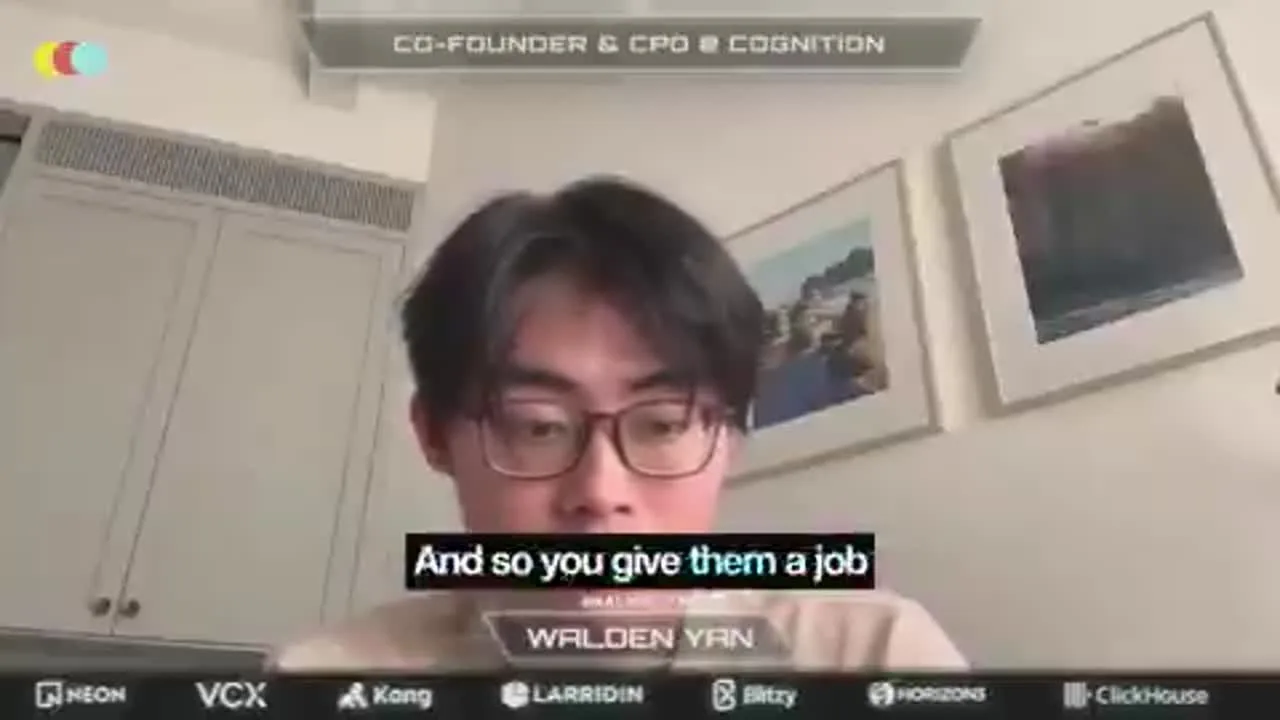
Frame from a November 2026 interview about Devin Bots.
Depth beats scale, and you make the call
Depth of use is how much real work you run through a tool, and for a solopreneur it counts for more than a big audience. An AI company CEO made this point about agentic products in November 2026: go deep with a few agents instead of shallow with many tools, and review their work yourself, because depth is what compounds.
Agentic products is the recursive effect. It's not the network effect.
"You don't need to have a billion users. You actually need to have a lot of depth in the users you have."
The human role does not disappear. It moves to oversight:
That one person company overseeing all the different agents that are doing work for you.
AI isn't just helping people work faster, it's changing what's possible for the solopreneur.
How to check your AI team in Pachat
One agent can be confidently wrong, and a solopreneur has no colleague to double-check it. Pachat is a web product at pachat.ai: Different personal AI agents, in one group chat. Here is how it fits:
- Go to pachat.ai.
- Put your Claude, Grok Bot, Muse and ChatGPT dots in one group chat.
- They check each other's facts and argue it out.
- Then you make the call.
You can read more in the AI group chat guide.
FAQ
What is AI for solopreneurs?
AI for solopreneurs is the practice of using AI workflows, automations and agents so that one person can run the work of a small team. In 2026 the pattern is consistent: automate repetitive tasks first, then give agents ongoing jobs such as email, support or releases. The solopreneur keeps the decisions, checks the quality and handles anything the agents hand back for help.
Do I need to be technical to use AI as a solopreneur?
No. Tools in 2026 let you describe what you want in plain English, and several solo founders say that AI now covers the technical knowledge that used to require a programmer. You still need a clear problem, a customer and the habit of checking results. A good first project is one small repetitive task, such as sorting email, handled by one agent for a month.
What should a solopreneur automate first?
Automate the repetitive work that eats your week: email, replies, scheduling and routine messages. Zapier, Make and AI workflows are the usual starting tools. Pick one task that repeats at least 5 times a week, automate it, and review the output for the first 2 weeks. Once it runs reliably, turn that automation into an agent that owns the task.
What is the difference between giving an agent a task and a job?
A task is a single request, such as changing the color of a button. A job is an ongoing responsibility, such as owning the release process or acting as a chief of staff. Devin Bots, launched in November 2026, are built around jobs: one agent keeps a goal and coordinates several sessions. A job needs a clear owner, a goal and a review point.
Can one person really run a company with AI agents?
Yes, and the data supports the trend. Stripe found that solo founders were 63% of new C-corporations formed through Stripe Atlas so far in Q2 2026. One human running about 20 specialized bots is described in Cognition's 2026 case. Results vary by business, and the person still oversees quality, handles exceptions and decides what happens next.
How many AI agents does a solopreneur need?
There is no fixed number. Start with 1 agent and 1 job, then add more only when the first one runs well. The Cognition case used about 20 specialized bots, but it began with a few roles such as design and release management. Each new agent adds oversight work, so grow at the pace you can review, ideally one new job every few weeks in 2026.
How can Pachat help a solopreneur?
Pachat is a web product for people who use more than one AI. Its official description: put your Claude, Grok Bot, Muse and ChatGPT dots in one group chat. They check each other's facts and argue it out, then you make the call. That gives a solo operator a second opinion in 2026 before acting on an agent's answer. Start at pachat.ai.
References
- @JeffHerschy, 2026-08-30: https://x.com/JeffHerschy/status/2094078480157716899
- @ai0echomind, 2026-07-01: https://x.com/ai0echomind/status/2072297549705138666
- @godsystemsmd, 2026-11-13: https://x.com/godsystemsmd/status/2121241697531101204
- @MTSlive, 2026-11-17: https://x.com/MTSlive/status/2122835083094798725
- @bncdotph, 2026-11-16: https://x.com/bncdotph/status/2122329715335983323
- @0xWuki, 2026-04-16: https://x.com/0xWuki/status/2044820955877306435
- Stripe, "Top solo founder traits," 2026: https://stripe.com/blog/top-solo-founder-traits
- Stripe Economics, "The Age of the Solopreneur": https://www.stripeeconomics.com/p/the-age-of-the-solopreneur
- Cognition, "Introducing Devin Bots," 17 November 2026: https://devin.ai/blog/introducing-devin-bots
- Fortune, 17 November 2026: https://fortune.com/2026/11/17/exclusive-cognition-bets-on-devin-bots-coding-agents-in-challenge-to-anthropics-duet-and-openais-dots/